
Leanne christian, ma, lcmhc
Licensed Clinical mental health counselor
Online therapy in NC for depression, anxiety, trauma, relationship issues, and a specialized group for skin picking and hair pulling (Body-Focused Repetitive Behaviors).
About
I am a human first. My most important job is to understand. In 15 years of work, I've learned that nothing is more valuable than the therapeutic relationship. I am the type of therapist that will remember the details of your life, celebrate wins with you, and over time point out patterns that we learn together. Anxiety, depression, trauma, life stress, or relationship problems...those are all exhausting enough without having to re-explain why something triggered you or how challenging it is to talk to a particular person in your life. You can choose how you want to do this: we can work on how to get through it and move forward, or we can explore where some of this might have originated and see what's there. My style is warm, honest, and collaborative.Body-focused repetitive behaviors can feel like they are impossible to stop. I run a structured group focused on helping people better understand and interrupt patterns like skin picking and hair pulling. This work uses practical, evidence-based strategies to build awareness, regulate urges, and create meaningful change. I also have personal experience with skin picking, which shapes my approach and deepens my understanding of how complex and frustrating these patterns can feel. My goal is to provide support that is both nonjudgmental and effective, helping you build real skills for lasting change.Get in touch!
individual therapy

I start therapy with understanding what you are thinking, feeling, and doing...and what you want to do about it. From there, I use an eclectic blend of therapies to see what patterns are keeping you stuck, curate meaningful & personal coping skills, and explore deeper meaningful experiences where they are relevant.Therapy is individual: some people benefit from structured skills while others need space to process difficult experiences - and some find a bit of both is helpful. If you're interested in the specific approaches I use, you'll find them below. Rather than following a rigid formula, I integrate different evidence-based therapies into a natural conversation, tailoring treatment to your goals. I invite collaboration, and you are always welcome to accept or reject ideas. I believe everyone has an innate capacity for healing; sometimes it simply needs the time, space, and support to emerge.Evidence-Based Approaches
Cognitive Behavioral Therapy, Motivational Interviewing, Dialectical Behavioral Therapy, Acceptance and Commitment Therapy, Trauma Focused-CBT. I also like to draw from therapies such as Somatic Therapy, Attachment-Based Therapy, and Internal Family Systems.
bfrb group therapy

Struggle with skin-picking or hair pulling?
This group is designed for people struggling with body-focused repetitive behaviors (BFRBs), also known as trichotillomania and dermatillomania.
It focuses on building awareness of patterns and triggers, understanding the urge cycle, and learning practical strategies to interrupt these behaviors.
The group is structured, skills-based, and supportive, and can also be done alongside individual therapy.
Intimate A smaller group allows for more individualized support, accountability, connection, and a space where you don’t feel lost or overlooked.Structured Meeting consistently over eight weeks helps build momentum, reinforce skills, and support you through real-life challenges as they come up.Practical You’ll learn clear, actionable and personalized strategies—not just talk about the problem, but actively work toward change.Applied The goal is to help you apply what you learn in the moments that matter most, so change actually sticks outside of sessionsEvidence-Based Cognitive Behavioral Therapy, Habit Reversal Training, Comprehensive Behavioral Treatment (ComB), Acceptance and Commitment Therapy, and Dialectical Behavioral Therapy
free offerings
Opening the Shame Shell
Shame can become its own barrier to BFRB treatment. It can make us hide, disconnect, judge ourselves, and feel even more stuck in the cycle.Opening the Shame Shell is a guided exercise designed to help you slow down and explore the shame that may have formed around your BFRB—and begin to relate to that shame differently.Drawing from the ideas explored in the article The Shell of Shame, this resource invites you to move beyond simply understanding shame and into the process of gently unpacking it.You don't have to shame yourself into change.You can start by understanding what the shame has been trying to protect.
Short reads
Where to Start A Roadmap for Managing your BFRBIs My Skin-Picking Out of Control? Or Is It Just Out of Awareness?The Sensory Lens of BFRBs Understanding One Underlying FunctionThe Shell of Shame An Antidote for the Barrier in BFRB TreatmentOn Prevalence and Compassion Living With Body-Focused Repetitive BehaviorsIf Evidence-Based Therapies Were High School Teachers The Best Therapy Is Not Always the Same TherapyWhat are Your Fingers Searching For? The Underlying Functions of Body-Focused Repetitive BehaviorsWhy "Just Stop Picking/Pulling" Doesn't Work And How to Respond to It.
Contact
Interested in BFRB group?
If you're interested or have questions, feel free to reach out—I'm happy to share more details and see if this feels like a good fit for you.Interested in individual therapy?
North Carolina704-750-9848
[email protected]
INSURANCE & FEES
Individual Therapy
I am in-network for the following North Carolina insurances: Aetna, BCBS, Cigna, EAP Cigna, United Healthcare/Optum, EAP United Healthcare/Optum, Amerihealth Administrators, GTEB, NC State Health Plan, VA Community Care Network (CCN)Self-pay rate: $150 per sessionBFRB Group
This group is offered as self-pay only.
$100/week, 8-week commitment
What clients are saying
I believe the best way to know whether a therapist is a good fit is to hear from people who have worked with them.
⭐⭐⭐⭐⭐ 64 verified reviews on Grow Therapy
Read my reviews →Do you offer telehealth throughout North Carolina?
Yes. I am licensed to practice anywhere in the state of North Carolina. For telehealth, that means I can work with anybody physically in NC when you sign on for a session.
Do you accept insurance?
Yes. Please see which insurances in a in-network with here
What happens during the first appointment?
In our first session, I will begin by reviewing documents you submit prior to ensure any questions are answered. I then like to get to know you by asking background information and learning what brings you to therapy. You are welcome to share as much as you feel comfortable with. We will then set goals and establish progress measures. I'll talk to you about my initial thoughts on how I can help you. We will also create a plan for follow-up sessions.
What are body-focused repetitive behaviors?
BFRB's are a set of compulsive behaviors involving grooming activities (like picking skin or pulling hair). They usually result in physical damage and emotional distress. They are automatic or emotionally-driven, meaning not something that you can "just stop" with sheer willpower.
How long does therapy usually take?
Of course, this depends. If you are here for something solution-focused or a problem that's perhaps present-focused or situational, it may take 3-6 months in therapy. Deeper work takes a bit longer, sometimes a year or more, to dive into. However, this usually begins with weekly sessions and tapers down to less frequency over time.
How will I know it's helping?
At our first or second session, we will determine when sort of measures to use to track progress objectively. Every 3 months, we review your goals, progress, and importantly check-in on whether you feel therapy is effective...or if we need to change course to a different modality or style.
To the complex question “Why am I picking my skin” or “Why am I pulling my hair”, the answer is anything but succinct. The ‘why’ in itself is a loaded question, and one of the W’s (who/what/when/where/why/how) we are taught be cautious using in graduate school when learning to become therapists. It can open rabbit holes to get to the ‘source’ of the behavior—often pointing to notions of trauma, anxiety, or OCD. To be clear, a diagnostic or historical explanation is important. But it doesn't necessarily tell us what function the behavior is serving in the moment. The search for a “why” can leave us with confusion and frustration. Simply asking ‘why’ and speculating (or even arriving at an answer) is less useful than considering a different form of the same question:Rather than: WHY AM I DOING THIS… Where did this come from? How can I explain it diagnostically?Consider: WHY AM I DOING THIS.. What function does it serve? What am I getting out of it?One lens for understanding the underlying function is the sensory lens. In the most basic definition, senses include what we can hear, see, smell, taste, and touch. Across the senses, we can be soothed, stimulated, or irritated depending on the input. When we eat a lemon, for example, there are various points on the continuum to land as far as how your sensory system appreciates (or does not appreciate) the experience.Imagine yourself at a noisy restaurant with a friend: What can you hear? People socializing, kitchen bustle, background music. To what degree does that soothe or stimulate your sense of hearing? What can you see? Lots of movement, dim lighting. How is that input experienced? What can you smell? Delicious food, your friend’s fragrance. Do you enjoy that? What do you taste? Is the food pleasant? Is the flavor in your palate? Finally, what do you feel? The comfort level of the chair, the temperature of the room. When you put all of this together, you get a matrix of your entire sensory experience.I do not like to eat a lemon. My salivary glands simultaneously recoil and excrete at the thought of the taste. But I do like the texture of a lemon. Similar to its sweeter relatives, the popping of the pulp is satisfying and interesting to me. The smell is also pleasant to me, refreshing and uplifting. I also appreciate the aesthetic of a lemon and see why it is included as a focal point in home decor and clothing.Will I ever be forced to eat a lemon? Unlikely. Will I be in a noisy restaurant? Probably. The point is that understanding how your sensory world is experienced influences your comfort, willingness, engagement, and ultimately your choices.The 3x5 ToolTo put this into a tangible tool targeting body-focused repetitive behaviors, I offer a 3x5 framework. The 5 indicates our five senses: what do I hear, see, smell, taste, and touch. The 3 breaks down a single episode of picking or pulling into sections: before, during, and after. Here is an example of how one might experience an episode skin-picking through a sensory lens:
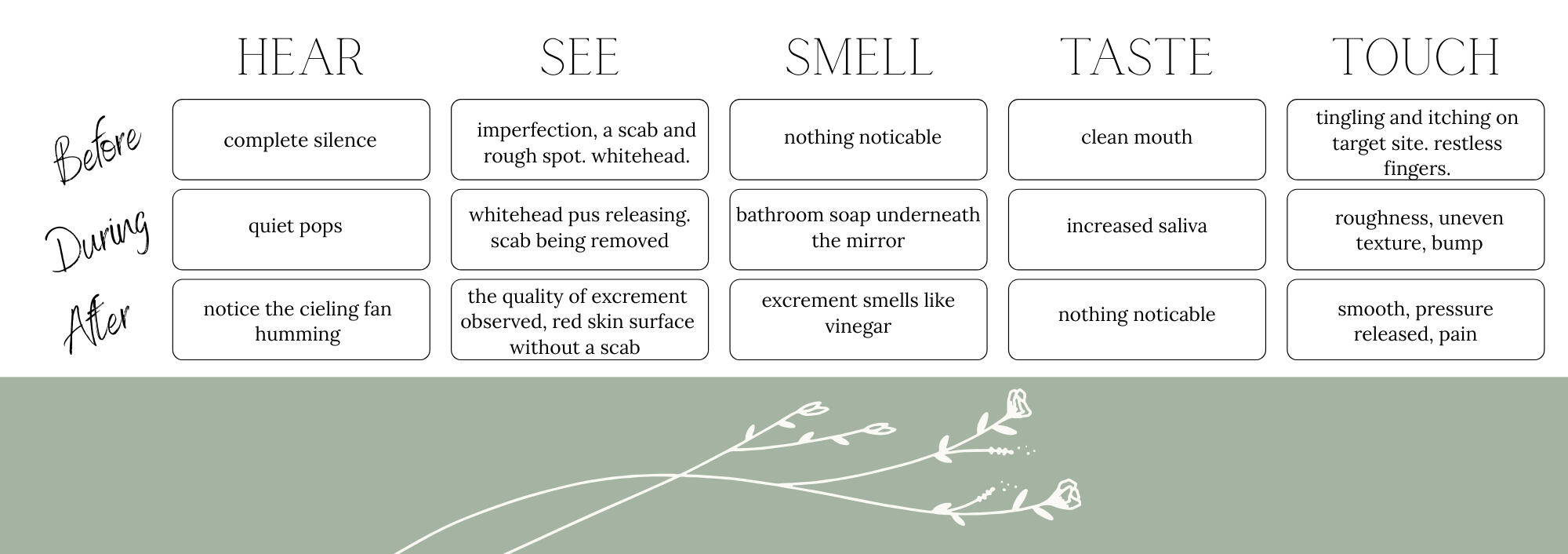
And here is the same 3x5 tool, applied to an example of hair-pulling:
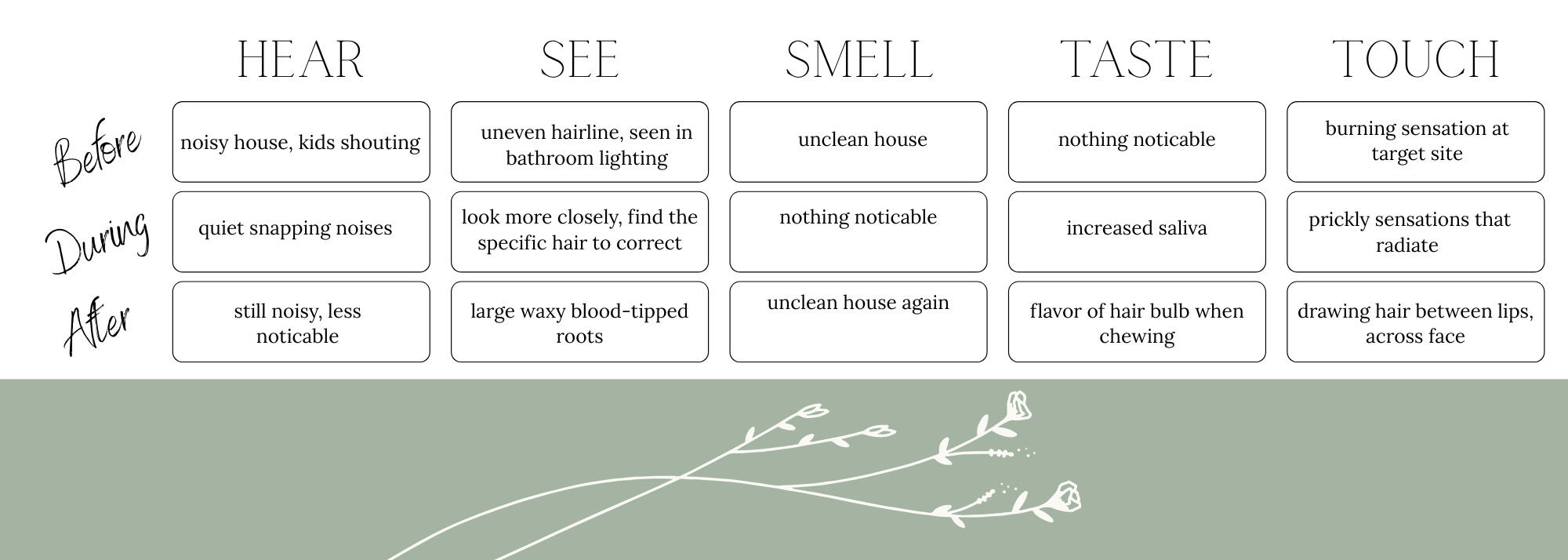
Although all of the senses are evaluated, for many people touch and vision can be particularly salient. But as you can see, we are always receiving sensory input—from lemons to restaurants, and certainly BFRBs—regardless of how aware we are of it. **For simplicity, this tool focuses on the five familiar senses, though our sensory experience is actually much broader than hearing, seeing, smelling, tasting, and touching.So why is this important? Well, for starters I cannot overstate the value of awareness when it comes to treating BFRBs. Some find that just the act of stopping to raise their awareness of their patterns results in a decrease in unwanted behaviors! Even people (myself included) who of course can describe their patterns to a tee intellectually (I mean, we’ve only been living with this for years) have something to gain from increasing awareness through a sensory lens.Moreover, this data gives direction on appropriate and meaningful interventions. The 3x5 Tool depicts which senses, at which point of the episode, are either under-stimulated or perhaps aggravated. So the task becomes: What sensory experience is my BFRB providing at this point—and is there another way to meet that sensory need? So now, creatively, we can look for which strategies make the most sense for your individual pattern through a sensory lens.The goal of looking at your BFRB through a sensory lens isn’t to find a single answer to the question, “Why do I do this?” It is to become more curious about what is happening in the moments before, during, and after the behavior. Your sensory experience may reveal patterns you have never noticed before—and those patterns can give you information about what your brain and body are seeking, avoiding, or responding to. The more we understand the function of a behavior, the more choices we have in how we respond to it. You don’t have to figure it all out at once. Start by noticing. What do you hear, see, smell, taste, and touch? What changes before, during, and after? What might your BFRB be giving you that your sensory system finds meaningful? Awareness isn’t the end of the work. It’s where the more useful questions begin.Thanks for reading!
If you’d like more on BFRBs:
If you’re looking for therapy, I provide virtual sessions for adults across North Carolina.
This post is for educational purposes and isn’t a substitute for individualized mental health care.
When you think about treatment for picking, pulling, or biting, it’s conventional to consider interventions that target the behavior. It’s common to search for tools that will interrupt it when it starts. It’s also essential to develop an awareness of what drives the urge for a specific individual.The goal is to learn how to manage—not necessarily eliminate—the lifelong symptoms that can produce (among many things) emotional turmoil, visible damage or physical pain to the surface of our bodies.But those concepts can become engulfed in a shell that keeps us from accessing them.That shell is shame, stigma, and isolation.Imagine trying to pry open a shell that has been tightly sealed in a hard layer of protection. On the inside, all of the tools are available to you: such as habit reversal, cognitive restructuring, and alternative ways to get your needs met.But you risk damaging the beauty of the shell in its entirety if you neglect the function of the container.Shame is more than a feeling. It is the words we tell ourselves and the attitude we hold toward the parts of ourselves we do not prefer. It says things like, “I am defective.” And it can feel heavy on our bodies to carry as armor.It thrives in isolation, believing “I am the only one” and “Nobody understands.”It is fed by stigma in the form of judgment or ignorance we perceive or experience from others.So how do we gently ease open the shell in order to receive the tools we desperately desire for change?The answer is ownership, compassion, and community.It is accepting that this is the thing we did not choose, but we choose to learn to live with.It is offering yourself loving-kindness.It is connecting with others who know and live your experience.You can respond to shame with words. You can replace statements of criticism with statements of curiosity. But if you do so in a vacuum, you miss the emotional experience of shame—and that cannot necessarily be articulated intellectually.I have yet to meet a person who works to elicit shame on purpose. Rather, it is an unwanted emotional experience that is all too familiar following an episode of unwanted behavior.Paradoxically, shame can become part of what maintains distress—and, for some people may contribute to the cycle itself.The antidote is experiencing your shame through a lens of compassion.Coaxing open the shell with gentle finesse rather than brute force.The practice must start with intention rather than reaction.Not only does this practice take courage, it often requires direction. If asked to conjure shame—or any difficult emotion, for that matter—and give it compassion without a roadmap, most people wouldn’t know where to begin.It is a process that is learned through experience rather than lecture.I invite you to try an exercise that taps into the power of community and shared experience: reading a series of statements that are commonly never said out loud among people with a BFRB.As you read, I ask that you sit with your feelings alongside your thoughts. Notice what happens in your body. And see if you can offer yourself even 2% of the compassion that you might naturally offer to another person who resonates with the same experience.Before you try one more tip, trick, or strategy that someone else has suggested for managing your BFRB, I ask that you to begin with the shell.Give self-compassion a try.
You may discover that we are the same, we are different, and we are not alone.Thanks for reading!
If you’d like more on BFRBs:
If you’re looking for therapy, I provide virtual sessions for adults across North Carolina.
This post is for educational purposes and isn’t a substitute for individualized mental health care.
You walk into a coffee shop. There are twenty people sitting quietly sipping their favorite drink. This happens to be a fancy coffee shop: it uses porcelain mugs with saucers. The ambience is what you’d expect and you take it all in. Relaxing music, the blended aroma of sweetness alongside the bitter coffee bean, the hustling of baristas behind the bar, and everybody privately entranced by their own experience. Some parties are quietly chatting, others scrolling their phones, while still others are focused on their laptops as they work remotely. Everybody appears content with the cup they’ve been given. You don’t know these twenty strangers. You don’t presume to wonder what they are talking about, listening to, or working on. You just observe your surroundings without judgment, perhaps even positive regard.Then you turn your focus towards yourself. Standing in line for your turn at the register, preparing to place your order. You are suddenly self-conscious, especially about the way you appear. Surely, you think, everybody in here notices my flaws as I see them so clearly on my skin and scalp. You berate yourself silently as you approach the counter. Everything is intensified in this moment: the sounds, the smells, even the pace of others movement. As the barista hands you your cup, you notice a small crack on the sipping edge. You pause for a moment, considering whether you should ask for a new mug. No, you decide. It’s barely a chip and my coffee will taste the same regardless. I don’t need to bring attention to it; it will be perfectly fine. You take a deep breath as you turn to find a chair.As you do, the entire room fades to black-and-white as though it is an old fashioned movie. The twenty strangers continue to sip their drinks as you scan the room. Everything slows down, the noise softens, and a sense of calm washes over you. You move closer to a comfortable seat and notice that one of those twenty strangers is not grayed out as the others are. That one stranger is experienced in full color. As you move closer, you notice that one stranger’s cup also has a chip in it and you begin to wonder if this person has considered exchanging their drink as you had. You wonder if this person also entered the room with self-consciousness and low confidence. Deep down, you wonder if this person might also believe they are the only one.You wonder if the stranger knows what it’s like to hide their hands. Or avoid bright lighting. Or search for wig recommendations. You wonder if this person promises themselves, “just one last time”, only to feel shame when unsuccessful. You wonder if they are living their life in hiding.Approximately one in twenty people lives with by a body-focused repetitive behavior. One in twenty people pick their skin, pull their hair, bite their nails, or chew the inside of their mouth.You sit down across from the stranger. As you do, you begin to feel what they feel. Think what they think. Hear what they are telling themself. Your heart breaks at the cascade of pain, and you shake your head “NO!” vigorously as you listen to the words you silently speak to yourself: “I am so ugly. I am weak. Why can’t I just stop? If I were stronger, I wouldn’t do this. I look disgusting. Nobody will ever accept me like this. People will think I’m crazy. I have to hide this. Everybody is staring at my skin. Everybody is staring at my hair. If anyone finds out, they will judge me. How could I let this happen again? I am unfixable.”You look at the stranger with compassion. You take your broken mug and place it alongside theirs. A warm smile crosses your face as you tell this person with all of your care, “We are human beings, not broken people. Our worth is not defined by our skin and scalps. Our strength is not measured by our willpower over something we did not choose.” You look down and reach for the stranger’s hands. When you lift your eyes again, you are staring back at the image of yourself. You take a deep breath as you whisper, “And we are not alone.”Thanks for reading!
If you’d like more on BFRBs:
If you’re looking for therapy, I provide virtual sessions for adults across North Carolina.
This post is for educational purposes and isn’t a substitute for individualized mental health care.
Every school—and every student—is different. Many therapists integrate ideas from several of these approaches rather than teaching from just one classroom.Welcome to Thoughtfully Human High, a specialized school for body-focused repetitive behaviors such as Trichotillomania (hair-pulling) and Dermatillomania (skin-picking). Here, we emphasize non-judgment, curiosity and acceptance over self-blame and shame.Allow us to introduce our valuable teachers, each supported by evidence-based research and all committed to teaching you how to manage your BFRB from their own unique perspective.First, our principal: Cognitive Behavioral Therapy (CBT). The overseeing concept from which all of our teachers derive their ideas. She reminds us that our thoughts, feelings, and behaviors are all connected. She understands that we all form our core beliefs—about ourselves, others, and the world—from our life experiences. She looks to challenge us in finding thoughts that are not serving us, recognizing the feelings that they produce, and finding behaviors to change in order to function more productively.Our science teacher, Habit Reversal Training, is quite meticulous. In his class, you will be increasing your awareness and finding competing responses. But don’t underestimate the simplicity of this—taking time to investigate your patterns takes dedication and courage to go under such a microscope. You might hear the teacher’s voice ringing in your ears: “Again”, “Let’s practice that one more time” and “Muscle memory matters.” It’s strongly encouraged (and definitely not cheating) for you to use your social supports for help in this class. Please note that this course is a prerequisite and not intended for long-term change independently.In art, your ComB teacher will dive further into your awareness. Much like looking at a complex painting, she will encourage you to notice what you feel, what needs are present, and what is triggering you. Interventions are chosen creatively and specifically for you as an individual, because no two paintings are alike.ACT, or literature class, is all about acceptance and commitment. Imagine your BFRB as though it were a recurring character in a novel. Mr. ACT believes that every good story has conflict. Rather than trying to rewrite or erase the difficult chapters, he'll encourage you to read them with curiosity and keep writing anyway. You'll learn that your thoughts, feelings, and urges are simply characters in your story. They may be loud. They may be persuasive. They may even be frightening. But they don't get to hold the pen. The author is you. Most importantly in this course, your story is guided by your values. Every choice you make is another sentence, another page, another chapter moving you toward the life you want to live.Finally, in P.E., our Dialectical and Behavioral Therapy teacher (DBT for short), brings us to handling feelings. No, it isn’t all about sports and exercise in here (but hey, those can definitely be a part of this course). Sometimes it’s actually about being still. Really what Ms. DBT teaches is emotion regulation and mindfulness. Name your feeling, own your feeling, increase mindfulness, and (much like that timed mile) tolerate distress.Note that none of our teachers will be sitting reading slides robotically while asking you to memorize answers for your multiple choice test. Each teacher teaches differently and notices the same problem with its own approach. You may even find that at times the teachers don’t necessarily see eye-to-eye, which can get a bit confusing. The key here is that, as you move through recovery, some teachers will resonate with you more while others will challenge you in ways you didn't expect. Sometimes you'll return to a favorite class. Other times, you'll discover you needed a different teacher all along.Will you graduate from high school? Yes. But, your progress will ebb and flow. Recovery from skin-picking and hair-pulling is not linear. Even after long periods of remission, the behaviors can reoccur. This is why it is important to always carry your teachers with you. Revisit them when you need to. And remember, at Thoughtfully Human High, compassion, non-judgment, and acceptance are always the best teachers.
Thanks for reading!
If you’d like more on BFRBs:
If you’re looking for therapy, I provide virtual sessions for adults across North Carolina.
This post is for educational purposes and isn’t a substitute for individualized mental health care.
Scanning, feeling, searching, aha! Something is off. I’ll just get this evened out. It’ll heal faster if I help it along. Everything will look correct without this one thing.Or…oops what did I do?! How much time has passed? Oh, my gosh how am I going to cover this up?In one version, we are actively seeking for imperfections with our fingers (or eyes) to fix. In the other, we don’t even notice we are picking skin or pulling hair until we are pulled out of the trance. Most people experience both at different times. In both versions, the need is much more than skin-deep.Sometimes your fingers are looking for stimulation…Sometimes the urge isn’t about the skin or hair at all—it’s about the sensation. Our fingers find a rough edge, coarse texture, or unevenness. Touching, rubbing, or removing it creates satisfying sensations. It’s the brief “got it” feeling that tells us things are okay again.Sometimes your fingers are looking for relief…Sometimes, the urge builds with uncomfortable emotions. Body-focused repetitive behaviors are often associated with anxiety. But they also happen with frustration, overwhelm, restlessness, anger, depression, guilt, or loneliness. Picking or pulling can be a way to release tension or pressure, like letting the air out of an overinflated balloon.Sometimes your fingers are looking for focus…This one often shows up as automatic picking, as it can occur while driving, watching TV, reading, working, or concentrating. While our minds are focused on one task, our fingers quietly find another. The movement gives just enough input to help our brains stay engaged, especially for those with a wandering minds.Sometimes your fingers are looking for completion…This is the perfectionism component. The need for things to be ‘just right’ or the promise of ‘just one more’. The right texture that is smoothed. The one hair that’s out of place. The blemish that feels unfinished. The imperfection that just won’t let go. Unfortunately, the more we try to perfect the area, the more new imperfections appear.And here is the really frustrating part: they work. For a moment, the itch is gone. Emotions discharge. Feelings regulate. The rough edge is smooth. Our senses are satisfied. We are temporarily distracted from our stressors. We feel rewarded. Our nervous systems get exactly what they were looking for.Our brains notice: “This helped before. Remember this.” The cycle is reinforced. But then, on comes guilt, shame or renewed anxiety…and the cycle begins again.Your fingers aren’t the enemy: they are messengers. Even if the strategy has become painful or frustrating, your fingers are responding to what your brain perceives as a need in that moment. The next time you catch them scanning or notice the damage afterward, ask them: “What are you looking for?”
Thanks for reading!
If you’d like more on BFRBs:
If you’re looking for therapy, I provide virtual sessions for adults across North Carolina.
This post is for educational purposes and isn’t a substitute for individualized mental health care.
When a bystander interrupts your habit with the over-simplified solution to “just stop picking”, it’s just so seemingly obvious that if we could then we would. Sometimes we pick or pull with focused intention, and other times it occurs automatically and we aren’t even aware we are doing it. Let’s break down why, in either scenario, the (usually well-intentioned) suggestion to “stop” just doesn’t work.Starting with the former: sometimes pulling or picking is inside of our awareness. It’s usually ingrained into a part of our routines, like maybe after getting out of the shower or standing in front of the mirror. In those moments, it’s like there are two tracks running in our mind: the rational one and the BFRB voice. The voice that tells us lies like “my skin needs to be smooth” or “this hair is not perfect, therefore it must go”. These permission-giving beliefs are strong enough to drown out what we know to be true: our other, quieter self saying “bumps and variations are normal human variations that do not require correcting. Inevitably, when the BFRB thought is acted on, the cycle continues. And there are all types of BFRB thoughts (cognitive distortions), ranging from “should” statements and perfectionism, slippery slope (for example, “I’ll just pull one”), to emotional reasoning (“I’ll feel better after I fix this”), and many more. So, essentially, an outsider suggesting “just stop” is not an idea that never dawned on us…it’s just one that has way less power than our automatic thoughts and behaviors.Then, there is automatic picking or pulling. This happens during routine parts of the day where picking or pulling has been habitually fused into our practice. Common examples are driving, watching tv, and sometimes even while sleeping. Stating the obvious, we cannot simply stop something that we are so unaware of in the moment. In fact, being interrupted with the redirect to “just stop” can produce a whole other set of frustration, shame, and defense. Typically, automatic picking or pulling is habitual, sensory-seeking, and emotionally regulating.Ironically, knowing this (even if it can’t be articulated) doesn’t stop many BRFB individuals from berating themselves with the same discipline expectation to simply stop. Trying to abstain from something that is so much more complicated than a habit just leads to feeling like a failure when it can’t be done.So, how do we respond to it? First, let’s shift to a focus of self-compassion over shame and blame. Body-focused repetitive behaviors are a diagnosable disorder in the DSM-5; something to understand and treat…and certainly not something that we have chosen to deal with (more on this in another post). When speaking to the self, take each impulse to get angry with yourself for ‘doing it again when I said I would stop’ and soften it into awareness, daresay curiosity, about what is happening. Maybe it’s simply noticing if you are doing it automatically or focused. Where am I, what am I doing, how am I feeling, what am I telling myself? Or, if reflecting afterward: Where was I, what was I doing, how has I feeling, what was I telling myself? Because the truth is that we can’t “just stop” without getting clear on what, when, and why we’re doing it.And to others? Those well-meaning and unhelpful comments can also be reframed internally. In moments of automatic behavior, as angry as it has made me, I’ve tried to filter the redirect to “stop” as a cue to raise my own awareness. Maybe, if it’s a support person, they’d be willing to change their language to something that is softer. Perhaps a phrase or word that helps you shift your attention, something as simple as “Hey, how are you feeling right now?”. As for the focused picking or pulling, advice to “just stop” generally comes from a place of ignorance, or sometimes even disdain. It’s for you to decide if this person is an ally or an adversary. To those who are not on our team, I say to set your boundaries accordingly. Verbally, that could look something like “That’s not helpful”. Internally, you’re shielding yourself from input that does not serve you. But for those who are on our support team, it’s okay to ask them for what you need. It’s okay to tell them that you’re not sure what you need, that you’re working on figuring it out, but right now you know that “just stop” is not the tool that is going to move you closer to gaining power over a BFRB.One thing I’d like you to remember:You can’t “just stop” something you don’t yet understand. Awareness and curiosity will take you further than shame ever will.Thanks for reading!
If you’d like more on BFRBs:
If you’re looking for therapy, I provide virtual sessions for adults across North Carolina.
This post is for educational purposes and isn’t a substitute for individualized mental health care.

I stopped my scroll today on one of those images depicting locus of control. A two-ring bullseye, the center of which identifies things we can control, such as our thoughts, attitudes, friendship selection, and emotions. The outer ring lists the things we cannot, like the future, other people’s behavior, or external events. I wondered, personally, where my BFRB of skin-picking belongs.
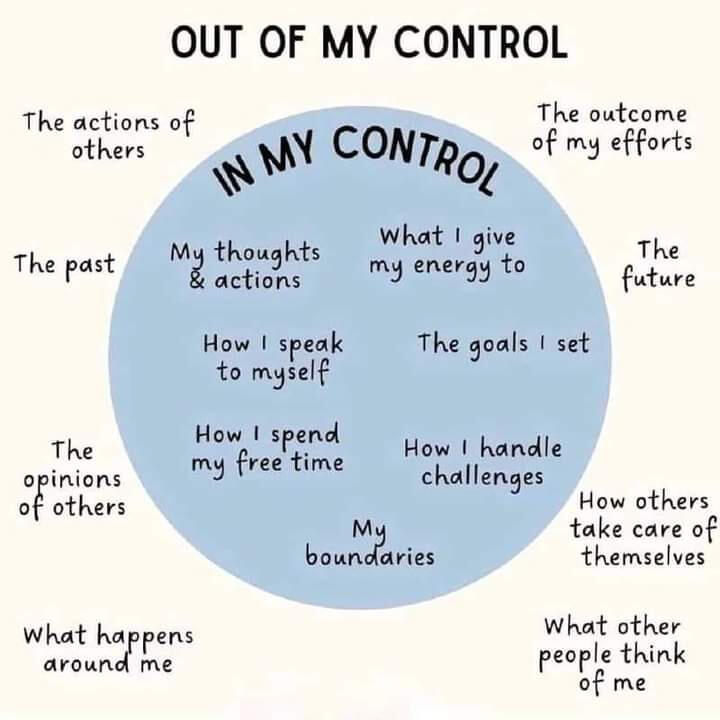
The concept of control is a loaded one here. There’s the idea that the behavior is out of control, as in it’s gone too far. Created too much damage. Cost too much of my precious time. Far beyond typical grooming.Then there’s the idea of control in itself being a function of the behavior. Something I can hone in on. An imperfection I can work to perfect. A productive task that brings a sense of accomplishment, perhaps when other areas of my life feel out of control.Finally, there’s the question of whether I am in control of the behavior, or if it is the disorder that is controlling me. There are two types of body-focused behaviors: focused and automatic. In the former, I have a conscious goal set on a target site. A specific piece of skin that needs to be picked, poked, popped, scraped, or smoothed. In the latter, the behavior is background noise. A filler activity secondary to whatever I’m doing. For me, something that is boring or requires focus like driving, watching tv, or reading. I’d argue for a third category, somewhere in between focused and automatic, where I am semi-aware of what I’m doing. But there is no research or documentation I’ve seen to support this as a separate type of picking episode.But to the question of whether I am in control of an episode-focused, automatic, or otherwise- I say yes I am. Although oftentimes I feel out of control in every sense of the word, I place my BFRB in the center of the bullseye.
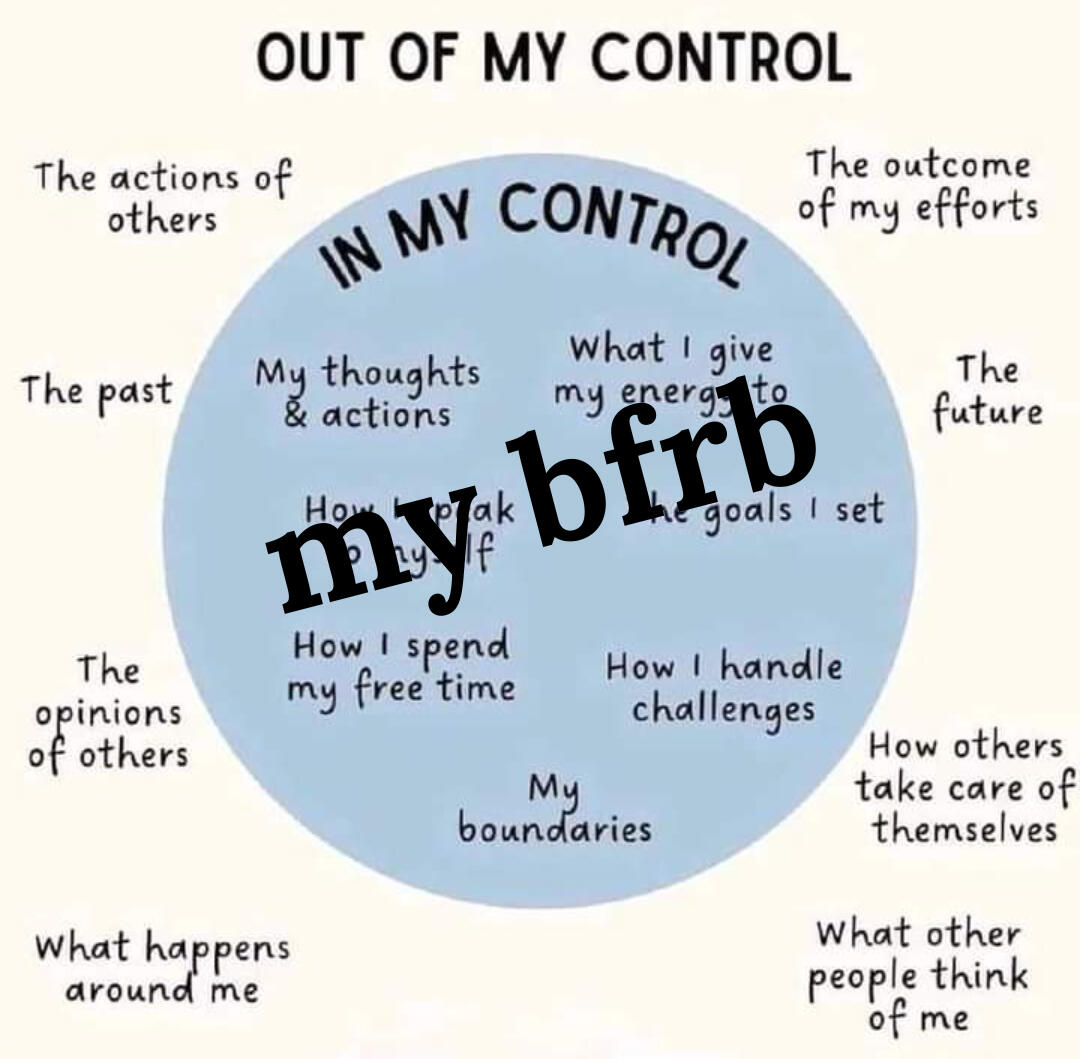
Here is my surprising rationale: AWARENESS.At the plain and obvious level, as is true with all of the other items in the center of the bullseye, one cannot change things of which they are not aware. I can’t change my thoughts without identifying them. I can’t change my feelings without owning them. I can’t change my behaviors until I look into a mirror (no pun intended).But it isn’t enough to be aware of the presence of the skin-picking. In truth, I have been painfully aware for most of my life. It needs to be more than skin-deep (okay, maybe I’m intending pun). “I am picking” awareness is huge, especially in the moment. Especially catching it in an automatic moment.It’s answering questions like:-when am I picking?-where am I?-what time is it?-who is around (or not around)?-what else am I doing (or was I just doing)?-how am I feeling?-what am I thinking?And that is the road to gaining control over the behavior. It is the way to unlock the answer about the function of the picking. It is the step towards making empowering choices about how to meet your needs differently. And in doing so, you’ve gained the ability to manage your BFRB rather than feeling controlled by it. It moves your picking, pulling, or biting right where it belongs-at the center of the bullseye.Thanks for reading!

If you’d like more on BFRBs:
If you’re looking for therapy, I provide virtual sessions for adults across North Carolina.
This post is for educational purposes and isn’t a substitute for individualized mental health care.
I have dermatillomania. Excoriation. Skin picking disorder. A mental health condition defined by the repeated, compulsive urge to pick, scratch, squeeze, or bite one's own skin, leading to physical damage and emotional distress. My friend has dermatillomania, too. We both want to stop the behavior that we have in common. So I ask my friend what works for her: how does she stop, what tools does she use, what products have helped, how many days has she been pick-free. She tells me. I’m overwhelmed with the options so I try all of those things. They work for me. Until they don’t. My skin-picking is back with more intensity than ever. Maybe it’s because I’m weak, maybe I didn’t do it right. Maybe I didn’t try hard enough. I feel like a failure. I see it in the mirror. Why did it work for her? I need to try again. Maybe something different this time. Where do I even start?The thing about body-focused repetitive behaviors is that they can look remarkably similar on the surface. The location of the picking might change, but in general we all can identify with the statement “I pick my skin”. Likewise, people with trichotillomania, a mental health condition that causes an irresistible urge to pull out one's own hair, share the experience “I pull my hair”. But that is where the similarities stop and the reality of the condition is a more intricate picture of one’s unique experience.Some people pick primarily when they are anxious; others find themselves picking when they are bored or understimulated. Some notice the urge building before they ever touch their hair; others realize they’ve been pulling only after they notice the damage. Some seek a particular sensation, like smoothness or texture; others are driven more by the relief, focus, or emotional shift that comes afterward. The list goes on. Speaking of which, I’ve created a resource of statements made by people with BFRBs—a collection I call The Shell of Shame—to help illustrate just how differently the same disorder can show up from one person to another.So while it does not necessarily help to blindly try out strategies that have worked for others, it is tremendously affirming to realize that we are not alone, and that reducing shame and opening ourselves to learning how to manage our picking and pulling begins with compassion.That is the very start. Next, build your community. Join support groups as an observer, an active participant, a seeker or a provider of support and solidarity to others. It’s a part of a larger self-care plan that should include mental, physical, emotional, environmental, recreational, spiritual, and professional elements. This foundation doesn’t have to be elaborate. It might mean getting enough sleep, spending time with people who make you feel understood, moving your body, creating a more supportive environment, making time for things you enjoy, tending to your spiritual life, or working with a professional who understands BFRBs. The goal isn’t to create a perfect self-care routine before you address the behavior. It’s to make sure you aren’t trying to manage a difficult behavior while running on empty.Now it’s time to understand your behavior. This is where a framework like SCAMP can provide a roadmap. SCAMP invites us to look at five areas that may influence a BFRB: Sensory, Cognitive, Affective, Motor, and Place. The purpose isn’t to determine which category is the answer. It’s to become curious about which factors are showing up in your particular experience—and which ones might give you an opportunity to intervene.That’s quite a lot. I’m a proponent of breaking this apart into smaller actions. Raising awareness of and approaching each component with an element of curiosity and experimentation. With a realistic goal of management rather than abstinence. The idea is small steps over overwhelming change.
Starting with S: sensory. Take some time to understand the underlying function and developing targeted strategies to meet that need in a less destructive way. For example, if you are seeking the sense of smoothness, find a fidget that can facilitate the experience of accomplishing a smooth surface that was once rough. Through trial and error, you find something to add to your personal toolkit for sensory management. It doesn’t need to be perfect before moving on to the next, it just needs to have momentum.Then introduce the C: cognitive perspective. What are you telling yourself that gives you permission to pick or pull? Is it accurate, helpful, aligned with your values, or supporting your needs? Do you need to challenge the thoughts, diffuse from them, or accept them? You add your answers to your toolkit.Now you add in the A: affective component. With the same nonjudgmental curiosity, you bring awareness to your emotions. You recognize if your behavior shows up alongside anxiety, shame, sadness, disappointment, depression, anger, frustration, boredom, irritation, or restlessness. You notice if transition times increase your vulnerability to using your picking or pulling to shift from one thing to the next. You find skills and supports to manage your emotions healthily and you add them to your toolkit.You move on to the M: motor domain. You ask yourself whether you are conscious or unconscious when you are doing the behavior. You look at the movements and circumstances surrounding it. Are you reaching for a particular spot automatically? Do certain routines put your hands on autopilot? You develop interventions to monitor yourself, create barriers, or interrupt your pattern with preparation and planning.Finally, you consider the P: place of your picking or pulling. Not just where you are when you engage in the behavior, but who you are with, the time of day, and whether you are using tools to help yourself. You decide on what changes you need to make in your environment to address these contributors in a practical way.This is why managing a BFRB rarely looks like finding the one thing that finally makes you stop. It looks more like learning your own pattern.
Maybe the strategy your friend swears by works beautifully for you. Maybe it works for three weeks and then stops. Maybe it never works at all. None of those outcomes mean you failed. They are information.
Your BFRB is your own. The sensory experiences, thoughts, emotions, movements, environments, and circumstances that surround it are uniquely yours. And as those things change, your needs—and the tools that help you—may change, too.
The goal isn't to build a perfect toolkit and follow it perfectly. It's to develop a growing understanding of yourself so that you have more options when the urge to pick or pull shows up.
Sometimes that means using a sensory strategy. Sometimes it means changing your environment. Sometimes it means responding differently to a thought or emotion. Sometimes it means doing nothing in that moment and simply noticing what is happening.
This is management: not a finish line, but an ongoing process of learning, experimenting, adjusting, and responding with curiosity rather than shame. You don't need to find the right answer for someone else's BFRB. You can start by finding out what makes sense for yours.Thanks for reading!
If you’d like more on BFRBs:
If you’re looking for therapy, I provide virtual sessions for adults across North Carolina.
This post is for educational purposes and isn’t a substitute for individualized mental health care.